The best digital business cards for teams do more than look good. They keep brand consistent across every employee, handle the admin overhead of managing people over time, and turn networking into measurable pipeline. Choosing the wrong platform means months of manual workarounds and no useful data at the end of an event.
Choosing a card as an individual is a simple decision. Choosing one for a team of 20, 50, or 200 people is not. You are selecting a system that governs how every employee presents your brand at every event, meeting, and first introduction. Most platforms do this adequately for solo users. Fewer do it well for teams. The differences show up in three places: how much control administrators actually have over what employees can change, how smoothly new hires and departures are handled, and whether the data coming off cards is useful for improving performance.
This guide compares the leading digital business card platforms on the challenges that matter for team buyers.
What Teams Actually Need from a Digital Business Card Platform
Before comparing platforms, it helps to be specific about what makes a team deployment succeed or fail. Brand consistency is the obvious requirement, but it is only the first one. Teams also need a way to add and remove users without creating manual work for administrators. They need lead capture that survives an event, exports cleanly, and tells them which employees are converting contacts and which are not. And they need pricing that does not become punishing as the team grows.
Any platform can produce a good-looking individual card. The question is whether it was built for organisations or retrofitted for them.
Maintaining Brand Consistency Across Every Employee Card
When a company sends 15 sales reps to an industry conference, 15 different versions of the company brand should not walk through the door. That is what happens without proper template controls: one employee has last year's logo, another has misspelled their title, a third has changed the brand colour to something that is not close to correct.
Umbel
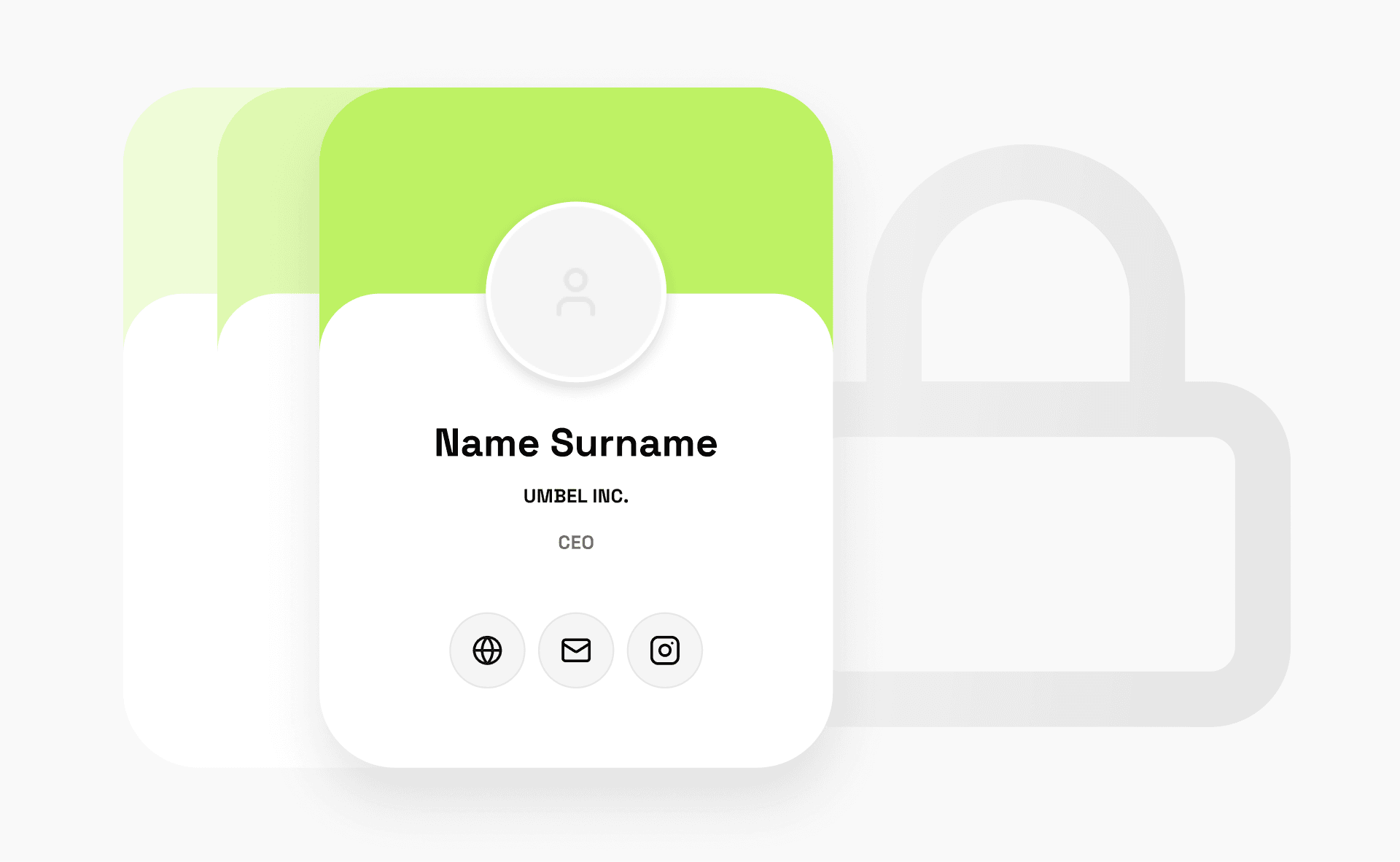
Umbel approaches brand control through a template system with four permission policies: Set Only, Assigned, Editable, and Excluded. An administrator defines the design once, including brand colours, logos, and fonts. Fields can be locked so employees cannot edit them, or opened so employees can fill in their own contact details. The brand stays consistent across the entire organisation without requiring anyone to check individual cards before events.
Updates push to all assigned cards immediately. If the company refreshes its logo two days before a trade show, every employee walks in with the updated card. No reprinting, no chasing staff to update their own cards.
Blinq
Blinq offers admin-defined templates with immutable design elements and is known for tight integration with Microsoft environments. It handles brand consistency well for organisations already running Microsoft infrastructure.
HiHello
HiHello provides team templates, but the degree of locking available to administrators is reported to be more limited at lower plan tiers. It suits teams where some design variation is acceptable rather than organisations that need strict enforcement.
Popl
Popl offers custom templates with branding options. The depth of administrative control available across plan tiers is worth confirming directly with their team, as reported capabilities vary across sources.
Onboarding and Offboarding Staff at Scale
Manual card creation for every new hire is not a process. It is a support queue. When an organisation brings on 30 people in a quarter, or loses staff and needs those cards deactivated, the platform's bulk management capability determines whether HR spends an afternoon on it or a week.
The offboarding side of this is underappreciated. A former employee whose card is still active and directing contacts to their old company details is a brand and data problem, not just an operational one.
Umbel
Umbel supports bulk CSV upload for creating and managing team members. Administrators upload a spreadsheet, cards are generated and assigned to the relevant template, and employees are issued access. Most organisations complete rollout within 48 hours using this approach.
Offboarding is handled at the admin level. Cards can be deactivated or reassigned without any action required from the departing employee. Different roles and permissions can be assigned to specific positions, so a new hire in a sales role gets the sales template without any manual configuration.
Blinq
Blinq handles provisioning through Microsoft Entra (Azure AD) for organisations using that infrastructure, which makes onboarding largely automated for eligible teams. The degree of automation available outside the Microsoft ecosystem is less clear.
HiHello
Based on third-party comparisons, HiHello is reported to require more manual input for each user at basic and mid-tier team plans. It works for teams with slow, predictable growth but becomes harder to manage as headcount scales quickly.
V1CE
V1CE offers some bulk management capability, generally at higher plan tiers. Their Plus Unlimited plan offers flat-rate pricing that can work well for larger teams.
Lead Capture and Follow-Up at Events
A business card without lead capture is a one-way exchange. The person sharing the card gets nothing back. For sales teams and event-heavy organisations, the ability to capture contact information directly from the card determines whether an event generates pipeline or just a stack of scanned contacts that sit in someone's phone.
Paper lead capture forms at events are notoriously unreliable. Handwriting is illegible, forms get lost, and no one knows which employee spoke to which contact.
Umbel
Umbel includes a lead capture form that lives directly on the card. Contacts fill in their details when they interact with the card. Leads are stored in the admin dashboard, where they can be filtered by card, department, time period, or event. The full lead list exports to CSV for use in any CRM or follow-up workflow.
This means an event manager reviewing leads on the Monday after a trade show can see which employees captured leads, how many, and from which interactions, without chasing anyone for their notes. The team can follow up with full context on where, who, and when each lead interacted with each employee.
Blinq
Blinq includes contact exchange and some lead capture functionality, with native integrations to CRMs including Salesforce and HubSpot available on paid plans. It suits teams already using those platforms who want contact data to flow directly into existing workflows.
Popl
Popl includes lead capture and has enterprise integrations available. Setup requirements vary depending on the integrations being configured and the organisation's existing stack.
V1CE
V1CE includes lead capture functionality. Integration options with external CRMs and tools are available natively; the specific connectivity that suits your stack is worth confirming directly with their team.
Tracking Individual and Team Performance
Most organisations have no idea which employees are effective at networking. They measure event ROI by cost and rough pipeline, not by individual contribution. A digital business card platform with analytics at the employee and department level turns that into something manageable and coachable.
Umbel
Umbel provides analytics at both the card and organisational level. Administrators can see card views, shares, click-through rates, and link clicks, sorted by individual and department. The lead system connects directly to this: an employee's card view count and lead capture rate are both visible in the same place, organised by event and time period.
This makes performance coaching concrete. Rather than telling an employee they need to network more at events, a manager can show specific numbers against the team average and have a useful conversation about what to change.
Blinq
Blinq provides card view and engagement analytics, though the depth of reporting is limited on standard plans.
HiHello
HiHello includes analytics. The depth of individual performance tracking across different plan tiers is not fully confirmed.
Popl
Popl provides analytics dashboards, with more detailed reporting available at higher plan levels.
Who Each Platform Suits
South African organisations managing teams of any size
Primary concern: local pricing, brand enforcement, and a system that does not require IT support to maintain.
Best choice: Umbel. At R49 per user per month (or R29 billed annually), Umbel is priced specifically for the South African market. The template system, bulk CSV management, lead capture, and performance analytics cover the full team use case without per-feature add-ons.
Teams running Microsoft infrastructure
Primary concern: automated provisioning through Azure AD and integration with Microsoft 365 tools.
Best choice: Blinq. For organisations where Microsoft Entra handles identity management, Blinq's native integration removes most of the onboarding overhead.
Large teams focused on flat-rate pricing
Primary concern: cost predictability as headcount grows.
Best choice: V1CE. Their Plus Unlimited plan offers flat-rate pricing that can reduce per-head cost at high headcounts, though some of the design control and lead capture granularity available in other platforms may be reduced.
Teams where individual card quality matters alongside admin control
Primary concern: design flexibility that still looks considered at the individual level.
Best choice: A closer comparison between Umbel and HiHello is worth running. Umbel's locking is stricter; HiHello's design flexibility is broader at the individual level.
Making the Decision
For most South African teams, the decision comes down to two things: how much control the organisation needs over what employees can change, and whether the platform can handle the admin overhead of managing people over time without creating additional work.
Umbel is built for organisations that need both. The template system handles brand enforcement, the CSV tools handle scale, the lead capture handles event ROI, and the pricing does not penalise growth. Competitors with deeper enterprise integrations, particularly around Microsoft environments, are worth considering if that infrastructure is already in place and the cost difference is justifiable for your team size.
To see how Umbel handles team setup, sign up at umbel.me
Ready to level up
your networking?
Create your premium digital business card in minutes and start making better connections today.
Get Started Free